
- test
- testing only
- IFOS DUBAI ENT WORLD CONGRESS 2023
- PARS Calendar
- PARS Calendar
- PARS Calender
- Report on the 9th Emirates Otorhinolaryngology conference Intercontinental Hotel Dubai Festival City, UAE
- PARS Calender
- Report on the 24th Rhino Egypt - 9th Pan Arab Rhinology Society Conference
- RhinoEgypt 24 & 9th PARS conference, March 8 - 10, 2018
Blood Loss During Adenoidectomy - Comparison of Radio frequency Ablation (Coblation) and Curettage
Michael S. Timms,1 Stephen J. Broomfield2
1King Faisal Specialist Hospital & Research Centre, Riyadh, KSA, 2Royal Blackburn Hospital, Blackburn, UK
Objective: Adenoidectomy by curettage remains one of the most commonly performed otolaryngological procedures, and can lead to troublesome bleeding. This has led to the introduction of newer techniques, including radiofrequency ablation (coblation), that aim to minimise blood loss. The aim of this study is to compare blood loss in adenoidectomy performed using coblation to that found using the curette technique.
Methods: Children undergoing adenoidectomy were prospectively included in the study. Those having simultaneous tonsillectomy were excluded. Demographic details and an assessment of adenoid size were recorded. Blood loss was measured by comparing pre and post-operative weights of swabs in the curette group and the suction apparatus and saline bag in the coblation group. Results were analysed using SPSS for windows.
Results: Twenty-three children were included in the study, 13 having adenoidectomy by curette and 10 by coblation. The two groups had similar ages and average adenoid size. The curette group had a mean blood loss of 24.1 mls (range 4.5 – 52.1, SD 13.78) and the coblation group a mean blood loss of 2.6 mls (range 1.7-3.4, SD 0.57). This difference was found to be statistically significant (p<0.001). There were no post-operative complications in either group.
Conclusion: This study confirms that, when performing adenoidectomy, the coblation technique has a significantly lower blood loss than the traditional curette technique.
Keywords: Adenoidectomy, Surgical blood loss.
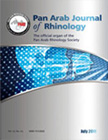 Once again one of our dreams has come true … it is my great pleasure to announce to you the Pan Arab Journal of Rhinology (PAJR) the official publication of the (PARS)
 Contact Us

Miss. Eman Ragab
Editorial Coordinator of PARS news
Editorial Assistant of PAJR
Executive Secretary of PARS
Webmaster
Head office: 87 El Manial St, El Ghamrawy Station, Cairo, Egypt
Mob:+002 01205633655
Email address: info@panarabrhinologysociety.com
